


Paradigms Regained - Unravelling The Mysteries Of Modern Science
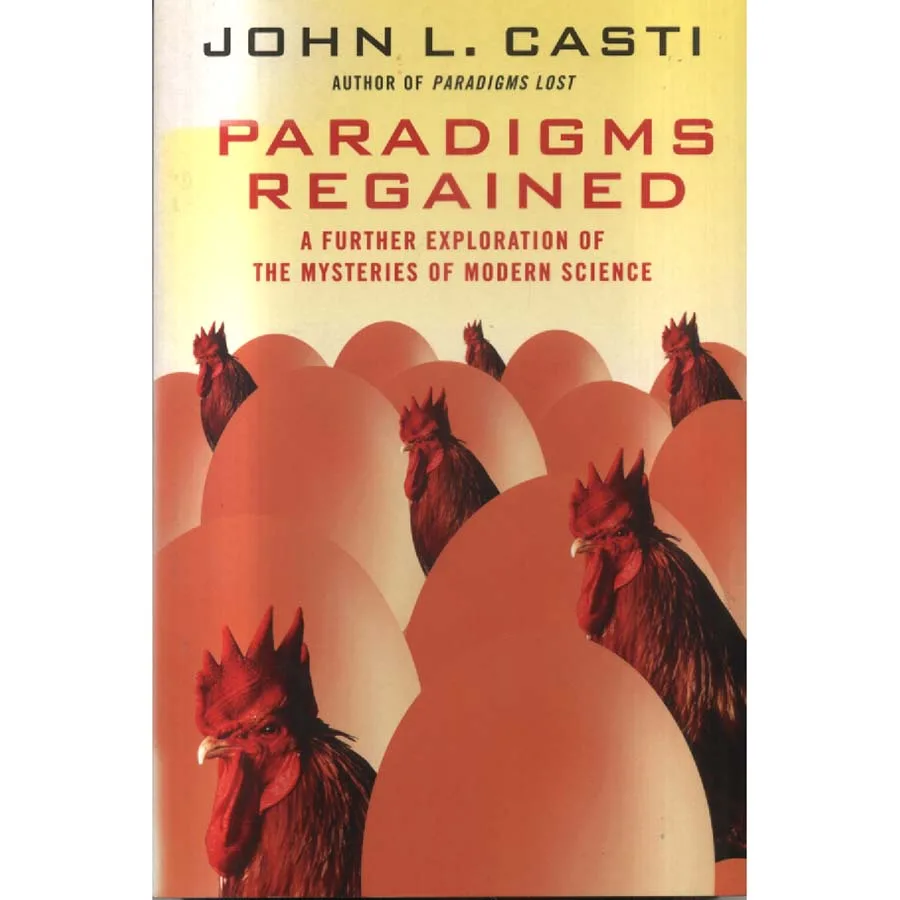
Publisher: Little Brown
Format: Paperback
ISBN: 9780316648165
Paradigms Regained: Unravelling the Mysteries of Modern Science (2000) – John L. Casti
Little, Brown | ISBN: 9780316648165
Condition: Good | Sold by Crappy Old Books
Science. Humanity’s magnificent attempt to understand the universe through observation, experimentation and the reassuring conviction that everything will eventually make sense if we collect enough data. Unfortunately, the universe has proved remarkably uncooperative, persistently presenting scientists with mysteries that refuse to disappear simply because somebody has acquired an expensive laboratory and a particularly impressive collection of equations.
Welcome to Paradigms Regained: Unravelling the Mysteries of Modern Science, John L. Casti’s entertaining expedition into some of the greatest unanswered questions confronting modern scientific thought.
Casti, a mathematician and science writer with a particular interest in complex systems, explores the boundaries between what science understands, what it suspects and what remains stubbornly beyond its grasp.
The questions are magnificent. How did life begin? Can computers genuinely think? What can mathematics tell us about the universe? Are there fundamental limits to scientific knowledge? And will scientists ever reach a point where they can confidently announce that everything has finally been sorted out and everybody may go home?
The answer to the last question appears regrettably unlikely.
Rather than simply celebrating established discoveries, Casti examines the competing theories and intellectual disagreements that make science such a fascinating enterprise. His approach recognises that scientific progress frequently begins not with triumphant certainty but with somebody noticing that a widely accepted explanation has developed an inconvenient hole.
The book ranges across the conceptual frontiers of modern science, where physics, biology, mathematics, computing and philosophy encounter questions that cannot always be answered by building a larger machine or conducting another experiment.
Particularly intriguing is the relationship between scientific models and reality. A theory may explain observations beautifully, predict outcomes with impressive accuracy and receive enthusiastic support from distinguished academics, only for some troublesome new evidence to suggest that everybody has overlooked something rather important.
This is the splendid irony of science: the more humanity discovers, the more sophisticated its ignorance becomes.
Casti brings intellectual energy and accessible explanations to subjects that might otherwise require several advanced degrees and an unusually high tolerance for mathematical notation. His aim is not to persuade readers that science possesses every answer, but to demonstrate why the remaining questions are so compelling.
Published in 2000, the book also offers a fascinating snapshot of scientific thinking at the turn of the millennium, when artificial intelligence, complexity theory and fundamental questions about life and consciousness were attracting growing attention.
Some discussions inevitably reflect the scientific understanding of their time, making the volume particularly interesting as a record of the theories, debates and expectations surrounding these subjects before another quarter-century of discoveries.
This 2000 Little, Brown edition, offered in Good condition by Crappy Old Books, is an appealing acquisition for readers interested in popular science, philosophy, mathematics and the extraordinary intellectual adventure of trying to understand existence.
A stimulating, thought-provoking journey through the mysteries that continue to challenge humanity’s brightest minds.
Because after centuries of scientific progress, mankind has learned to split atoms, explore distant planets, manipulate genes and build machines capable of performing billions of calculations per second.
Yet we are still arguing about some of the most fundamental questions imaginable.
A magnificent achievement for a species that occasionally struggles to operate the television remote control.
Keep browsing: See more Academic books Other books by John L Casti
